Crime musical Emilia Pérez scored 13 nominations at the 2025 Oscars, demonstrating just how out of touch the Academy is with marginalized communities.
News of all things scary
It was somewhere around the mid-1990s when animal horror came back into style. Not since the first cinema cycles of ecological and natural horror, specifically the ’50s through the ‘70s, had there been such a stampede of creature-caused carnage. Jurassic Park was a key influence in this new wave of faunal frights, however, Anaconda and Lake Placid are better blueprints for what all came next. The DNA of those two films can be sensed in the more modestly made Crocodile (2000), which stands out from the pack on account of its director, Tobe Hooper.
As Hooper fans know, Crocodile was not the first work of his to have a major croc component; Eaten Alive showed the guests of the Starlight Hotel becoming meals for the proprietor’s scaly pet. Observant viewers may wonder if these two Hooper horrors are connected, seeing as they have parallels, such as man-eating reptiles and deranged hoteliers. A hixploitation element is also present — and random — in Crocodile, albeit minimally. Whereas in Eaten Alive, the story is, at least atmospherically, Southern fried. So although the films are self-contained, there is occasional overlap on the surface.
Only one species of crocodile is endemic to the U.S., but Hooper’s film is neither set in Florida nor does it star an American crocodile. The gargantuan here is really a Nile specimen, she resides somewhere in California, and she is the centerpiece of Crocodile’s in-universe folklore. For sure, young people fall prey to a bloodthirsty killer here, yet this film feels the most like a traditional teen slasher when, early on, the characters sit around a campfire and soak up a story about the legendary “Flat Dog.”

Image: Caitlin Martin and Mark McLachlan’s characters scold Chris Solari and Greg Wayne’s characters.
After the story’s collegiate characters arrive at their Spring Break destination, Crocodile provides an always genre-approved infodump about the antagonist in store. As the storyteller among these eight co-eds explains, an early 20th-century hotel owner named Harlan Clemens turned his African import into a worshipped idol. This led to a kind of cult following before the townsfolk grew tired of Clemens’ “un-Christian” ways. The shrine to Flat Dog, along with her freshly laid eggs, was destroyed, and now she haunts Lake Sobek. This backstory of an abandoned, crocodilian goddess would have made for a more interesting film, but alas, that is not what Hooper made.
The only curvature of Crocodile lies in the film’s namesake. Indeed, the story is straightforward, and the maternal menace is often more serpentine and agile than nature ever intended. However, the script — the work of Boaz Davidson and Michael D. Weiss, then partners Adam Gierasch and Jace Anderson — brought out a sympathetic quality in Flat Dog. That aspect, the central conceit of the story, echoes various past animal horror films; the dangerous creature is acting on human emotions and ethics. And if any director knows how to steer a murderous frenzy and let anguish and rage run rampant, it would be Hooper.
Devastated by industrial capitalism, the family in Hooper’s The Texas Chain Saw Massacre (1974) was left to fend for itself. On a different but similar wavelength, Flat Dog was forced to live in a world not of her own, then persevere in that increasingly grim environment where hers and her family’s survival demanded drastic measures. Following that train of thought, the eponymous star of Crocodile is also something of a victim herself. The very waters she escaped to, following the downfall of her sanctum, have become gradually unsafe, especially around tourist seasons. Not only are there the locals who endanger her offspring, there are now heedless vacationers whose first response to seeing a nest of eggs is to violate them. These visiting trespassers manhandle and pilfer the eggs, and their pet dog consumes the rest. Flat Dog’s response is, understandably, merciless.

Image: Flat Dog finds the guilty party.
While the human characters in other natural horror films have been known to just be in the wrong place at the wrong time, the ones in Crocodile are directly paying for their lapse in judgment. Not everyone among this group is guilty of a crime against nature, but they are guilty by association — and that is plenty of reason for Flat Dog to mete out swift, godlike punishment. Other similar films find animals fighting back after an age of maltreatment or contamination, or they are fed up with the invasion and man-made deterioration of their territory. At that point, these films are contradicting the notion of natural because they have created a sort of “supernature” where perceived threats are dealt with accordingly as well as abnormally. Crocodile is not so eco-conscious, given how Flat Dog is really exacting her own revenge as opposed to being Mother Nature’s enforcer.
With Crocodile anthropomorphizing Flat Dog, namely giving her the drive to stalk and kill for her family, the film removes a good deal of humanness from the actual human characters. The most rational of the lot, Brady (Mark McLachlan) and girlfriend Claire (Caitlin Martin), are simply charged with complicity, but their friends — primarily doofus Duncan (Chris Solari) and the other men — are responsible for the ensuing carnage. Funnily enough, the crocodile is the most compassionate character here, based on the film’s ending. Duncan and his fellow knaves, on the other hand, are unkind without delay and apologies. The staggering lack of inhibitions is not exclusive to the guys either; Brady’s drunken one-night stand, Sunny, (Sommer Knight), wantonly spills the beans to Claire.
So after spending enough — too much — time with the film’s deathbound, it is reasonable to believe there was intention in designing Duncan and his crew to be insufferable. Despite producer Frank DeMartini insisting that audiences would “really care about these people,” sympathy is close to inconceivable. Having said that, there was a burgeoning tendency in horror back then, particularly any film with a growing body count, to allow vexing and hollow characters to proliferate on screen, provided that their fatalities were over the top, vicious and gratifying to watch. Crocodile was, in that way, ahead of its time.

Image: Claire returns Flat Dog’s egg.
The main draw of a film like Crocodile is its titular star. Unfortunately, Flat Dog is only a marginal success, as far as special effects go. KNB EFX Group, which was founded by Robert Kurtzman, Greg Nicotero and Howard Berger, is responsible for the practical crocodile. Partly using equipment left over from Eraser — its reptile house set-piece — KNB crafted four variations of the Lake Sobek monster, including an inspiring animatronic head for “eating” scenes. These impressive models were used for swimming or close-ups, but full-body shots were, regrettably, done with Flat Earth Productions’ CGI. If the choice was to either have a chintzy digital croc or no wide shots at all, then informed viewers surely would have accepted just KNB’s maw and tail.
The hurdles when watching this film are higher than desired, yet on occasion, it overcomes itself and entertains. The visit to the ‘gator farm and the interactions between cops and bumpkins ooze classic Hooper, and a whit of the night sequences, such as the quarrelsome trek through the woods and the store slaughter, are genuinely fun.
Without delivering any more blows to its already soft and bruised underbelly, Crocodile is a film whose virtues, few as they may be, go unnoticed. Yes, it was obvious that Tobe Hooper was not the same director he once was — also being mindful of the fact that his career highs are now horror benchmarks — however, he still managed to put his signature on an otherwise by-the-numbers production. That Hooper stamp is apparent where least expected but also much appreciated whenever wading through the rest of this silly film.
Horror contemplates in great detail how young people handle inordinate situations and all of life’s unexpected challenges. While the genre forces characters of every age to face their fears, it is especially interested in how youths might fare in life-or-death scenarios.
The column Young Blood is dedicated to horror stories for and about teenagers, as well as other young folks on the brink of terror.

Image: The poster for Crocodile.
The post ‘Crocodile’ – Biting Back into Tobe Hooper’s 2000 Nature Slasher appeared first on Bloody Disgusting!.
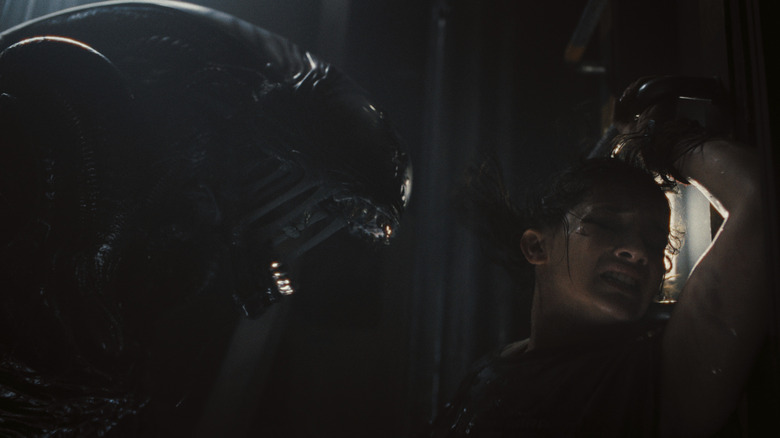
It’s a big day for the Alien franchise, with Fede Alvarez’s Alien: Romulus officially receiving an Oscar nomination this morning for Best Visual Effects. But that wasn’t the only Alien news for today, as rumors began swirling earlier this afternoon that Alvarez and company are looking to bring Sigourney Weaver’s Ellen Ripley back to the screen for the sequel to Romulus.
The rumor originated from scooper Daniel Richtman. He writes, “For the next Alien movie, they’re considering bringing back Ripley (Sigourney Weaver) using de-aging technology.”
Is there any truth to the rumor? Well, Fede Alvarez himself has taken to Twitter to completely debunk the report. “Fun gossip,” he responds to the rumor. “But not true at all.”
We do know that Alvarez and co-writer Rodo Sayagues are indeed developing a sequel to Alien: Romulus, with the film expected to center on the two survivors of last year’s movie: Cailee Spaeny’s Rain and David Jonsson’s Andy. Alvarez told Empire earlier this month, “I think it’ll be so exciting to go with characters you know from this movie, to a place in the Alien franchise that we’ve never been before, and to discover things that you’ve never seen before.”
So where is Ellen Ripley during the events of Alien: Romulus, you might be wondering? The film takes place between the events of Alien and Aliens, with Rain and friends encountering the Xenomorphs approximately 20 years after Alien and roughly 30 years before Aliens.
As you may recall, Aliens revealed that Ripley was in stasis aboard an escape shuttle (known as the Narcissus) for 57 years after the events of Alien, which would mean that Ripley is very much still floating around out there during the events of Alien: Romulus. Her journey to the Sulaco is still far from over during the events of Alien: Romulus, if these timelines all line up.
But would Sigourney Weaver actually agree to a return to the franchise, if she was asked? Back in August 2024, the actress shared that she would “consider it” if the script excited her.
“How much does the public really need or want another Ripley movie?” Weaver pondered. “I don’t really sit around and think about it, but if it came up, I would consider it. It has come up a bunch of times, but I’m also busy doing other things. Ripley has earned her rest.”
Fun gossip. But not true at all.
— Fede Alvarez (@fedalvar) January 23, 2025
The post Fede Alvarez Shoots Down Rumors of Ellen Ripley Returning for ‘Alien: Romulus’ Sequel appeared first on Bloody Disgusting!.
It’s no secret that Joe Dante’s Gremlins was originally written as a much darker film than it ended up being, with infamous scenes including Billy’s mom getting beheaded and his dog being eaten by the Gremlins ultimately being axed from the script before production began. The beloved holiday classic of course ended up being a PG-rated movie, but even that final version of the movie proved to be a little too much for some family audiences at the time.
As director Joe Dante himself has explained, “I think people were upset… They felt like they had been sold something family friendly and it wasn’t entirely family friendly.”
In fact, Gremlins is one of the movies that led the MPAA to create the PG-13 rating in 1984, a new rating somewhere between PG and R that felt a bit more suited to a movie like Gremlins.
This whole ordeal is explored in-depth in Kyle Conley’s YouTube documentary How Horror Created the PG-13, which provides “a history of how Spielberg productions Indiana Jones and the Temple of Doom and Gremlins caused such a firestorm, the MPAA created a new rating.”
The video, which you’ll find embedded below, features fresh insights from Joe Dante, and what’s particularly interesting about the video is that Dante provided Conley with a never-before-seen image from a moment that ended up on the Gremlins cutting room floor. It’s shared within the video, providing a rare insight into a darker version we could’ve gotten.
Conley explains to BD, “Joe presented me with something very special, a still image of the original death of Glynn Turman removed after the MPAA nearly gave the film an R.”

‘Gremlins’ (1984)
Glynn Turman played Roy Hanson in Gremlins, the biology teacher at Kingston Falls Middle School who gets killed by the Gremlins. Originally, Billy Peltzer discovers his dead body with multiple syringes sticking out of his face and torso, a reveal that didn’t end up making it into the movie. Instead, Billy discovers the teacher’s body with a single syringe sticking out of his rear end in the final cut, a decidedly less sinister take on the original reveal of his corpse.
Joe Dante explains in Conley’s new video, “The science teacher is one of the first victims of the Gremlins. He had previously upset one of the other Gremlins by poking him with a syringe. So the revenge that the Gremlins take on him is to stick him with a syringe. In the movie, it’s just sticking out of his rear end. But we shot a scene of his face covered in syringes. And it was very creepy. We shot that, it was in the preview [screening], and it was suggested that it would be better to not have that in the picture. I can’t regret anything not being in that movie.”
Another shot excised from the final cut of Gremlins gave us a better look at the Gremlin stabbed to death by Lynn Peltzer (Frances Lee McCain) in the Peltzer kitchen, the monster clutching a knife that’s embedded in its chest with green blood pouring from the wound. Dante has also released that deleted shot (seen below), and he’s selling prints in his online shop.
You can watch Kyle Conley’s full exploration of Gremlins‘ darker side below, which features a colorized recreation of what Roy Hanson’s death reveal would have originally looked like.

Photo Credit: Joe Dante

Photo Credit: Joe Dante
The post Joe Dante Shares Rare Images from the Darker Version of ‘Gremlins’ appeared first on Bloody Disgusting!.
In addition to the just announced 13th century werewolf movie Werwulf for Focus Features, director Robert Eggers (The Witch, Nosferatu) will also be writing and directing a follow-up to the Jim Henson classic Labyrinth for TriStar Pictures, Deadline reports this afternoon.
According to the outlet, Eggers has “closed a deal” to make the movie for TriStar.
Deadline further details, “Plot details for Eggers’ Labyrinth are under wraps, but we’re told the film is a sequel, rather than a remake of Jim Henson’s 1986 classic.”
In Labyrinth, which starred David Bowie and Jennifer Connelly…
A 16-year old girl is given 13 hours to solve a labyrinth and rescue her baby brother when her wish for him to be taken away is granted by the Goblin King.
Eggers is co-writing the script with frequent collaborator Sjón (The Northman, Werwulf). Chris and Eleanor Columbus (Nosferatu, Werwulf) will produce alongside Lisa Henson.
Brian Henson will be executive producing Eggers’ Labyrinth sequel.
Fede Alvarez (Evil Dead) had originally been scheduled to direct a sequel to Jim Henson’s classic 1986 movie, while Scott Derrickson (Sinister) had more recently been attached.
The original Labyrinth was directed by the late Jim Henson in the direct wake of The Dark Crystal, and though it wasn’t a smash hit at the box office at the time, the years have been kind to the 1980s movie. It’s fondly remembered for David Bowie’s performance (and costume) as Jareth the Goblin King, as well as the puppet work from Jim Henson’s Creature Shop.
While the original movie never did spawn any follow-up film projects, the world of Henson’s Labyrinth has expanded over the years with various books, video games and comics.

The post Robert Eggers Writing and Directing New ‘Labyrinth’ Movie for TriStar Pictures appeared first on Bloody Disgusting!.
Fresh off Nosferatu being nominated for four Academy Awards, Bloody Disgusting is excited to announce that visionary director Robert Eggers has hand-selected eight movies that influenced his gothic-horror hit feature for Conjuring Nosferatu: Robert Eggers Presents, an upcoming series from Film at Lincoln Center that’s being presented this February.
Presented from February 5 through February 9, the program kicks off with a special 35mm screening of Nosferatu, joined by eight films selected by Eggers as companion pieces.
“I am honored to share this collection of films that inspired my adaptation of Nosferatu,” Eggers said in a statement. “It’s a world of Gothic Romance, fairy tales, and folklore, made by filmmakers with a passion to transport the audience to another time, another place, and another way of thinking and believing.”
Eggers continues, “From the overwhelmingly atmospheric work of David Lean or Thorold Dickinson’s Queen of Spades that utilize massive set builds on soundstages—to the visually naïve and yet terrifying She-Butterfly by Serbian filmmaker Đordje Kadijević, all the films have the ability to enthrall your imagination and make you a believer yourself.”
Join FLC for this special series made up of the films that inspired Eggers’s spellbinding new take on fiction’s most famous monster, an eclectic can’t-miss array of gothic Hollywood deep cuts, rare works of Eastern European folk horror, and captivating evocations of 18th-century England, as well as a special screening on 35mm of his own Nosferatu.
Tickets will go on sale on January 17 at 2pm, with an early access period for FLC Members starting January 17 at noon. Tickets are $17; $14 for students, seniors (62+), and persons with disabilities; and $12 for FLC Members. See more and save with 3+ Film Package ($15 for GP; $12 for students, seniors (62+), and persons with disabilities; and $10 for FLC Members).
All films screen in the Walter Reade Theater (165 W. 65th St.) or Francesca Beale Theater (144 W. 65th St.). Here’s the full lineup of films that Eggers has hand-selected for you…
Robert Eggers, 2024, U.S., 35mm, 132m

For his fourth feature film, Robert Eggers exhumes what might be considered the urtext for all horror cinema: F.W. Murnau’s landmark masterpiece, 1922’s Nosferatu (itself an adaptation, or perhaps more accurately a transformation, of Bram Stoker’s 1897 novel, Dracula).
Thomas Hutter (Nicholas Hoult) seeks to provide financial stability for his wife Ellen (Lily-Rose Depp) by selling a decrepit local villa to a Transylvanian nobleman, the reclusive Count Orlok (Bill Skarsgård). Hutter’s journey is marked by myriad strange and frightening events, but little does he know that his otherworldly encounter with Orlok will summon a seemingly unstoppable, plague-like evil to his own doorstep.
Rendered with all of the rich detail and disarming atmospherics that have characterized his work to date, Nosferatu is Eggers at the height of his powers: an astonishing, meticulously crafted, and oddly touching parable about desire, disease, and death. Also featuring Aaron Taylor-Johnson, Emma Corrin, Willem Dafoe, and others. A Focus Features release.
Wednesday, February 5 at 6:00pm at the Walter Reade Theater
Archie Mayo, 1931, U.S., 16mm, 81m

A Pre-Code sound take on George du Maurier’s 1894 novel Trilby, this eerie mystery stars John Barrymore as the titular music teacher, who controls (and ultimately destroys) the young women under his tutelage through his curious powers of suggestion. Svengali sets his sights on Trilby O’Farrell (Marian Marsh), an artist’s model, and the sinister teacher’s pattern of manipulation and ruin seems to be repeating itself yet again—but Trilby’s old lover, Billee (Bramwell Fletcher), seeks to discover the truth about Svengali’s hypnotic influence.
Barrymore’s turn in the lead role is itself a feat of silver-screen mesmerism, portraying Svengali as a cruel yet magnetic figure who wields his own charisma as an instrument of terrible power. 16mm collection print courtesy of the UCLA Film & Television Archive.
Thursday, February 6 at 6:15pm at the Francesca Beale Theater
Jean Cocteau, 1946, France, 35mm, 96m
French with English subtitles

Among world cinema’s greatest fairy tales, Jean Cocteau’s 1946 adaptation of Jeanne-Marie Leprince de Beaumont’s 1757 story endures as one of the medium’s most beloved and influential fantasies. Jean Marais (as the feral Beast) and Josette Day (as the young Beauty who transforms his heart) turn in historically romantic and utterly magnetic performances that, combined with a delirious array of exquisite sets and costumes and Cocteau’s penchant for harnessing the artifice of filmmaking to conjure a world beyond and yet within our own, cohere into a timeless reflection on wonder, romantic desire, and death.
Friday, February 7 at 6:00pm at the Walter Reade Theater
Saturday, February 8 at 1:30pm at the Walter Reade Theater
David Lean, 1946, U.K., 118m

Perhaps the definitive film adaptation of Charles Dickens, David Lean’s classic 1946 rendition endures as one of the all-time great (and most faithful) transfigurations of literature into cinema. The timeless story of orphan Pip (Anthony Wager and John Mills) as he grows up in 1810s London with the help of an unknown benefactor, Great Expectations—the first of Lean’s signature takes on Dickens, the other being 1948’s Oliver Twist—is powered by an astonishing ensemble cast, assembled by production company Cineguild, including Valerie Hobson, Jean Simmons, Alec Guinness, William Currie, Martita Hunt, and others. But most pertinent here: the film’s graceful, dimensional depiction of 19th-century England, expertly photographed by DP Guy Green.
Saturday, February 8 at 3:45pm at the Walter Reade Theater
Thorold Dickinson, 1949, U.K., 95m

Drawing from Alexander Pushkin’s short story of the same title, Thorold Dickinson’s stunning, baroque fantasy conjures a sense of the supernatural that verges on the surreal. Set in 1806, the film follows a Russian military officer (Anton Walbrook) who seeks to learn the secret of a countess (Edith Evans) who purportedly sold her soul in exchange for learning the secret to winning high-stakes card games. He (along with a friend and fellow officer) begins courting the countess’s young ward in the hopes of getting closer to the countess, but soon enough his scheme goes badly sideways—and, perhaps, supernatural. An object lesson in the power of cinema to evoke atmosphere and the sense of an invisible world beyond the veil of the visible.
Friday, February 7 at 8:15pm at the Walter Reade Theater
Sunday, February 9 at 5:15pm at the Walter Reade Theater
Yakov Bazelyan, Sergei Parajanov, 1954, USSR, 63m
Russian with English subtitles

Sergei Parajanov’s feature debut was this mesmerizing fairy tale adaptation, drawn from the work of Moldavian writer/poet Emilian Bukov. The story concerns a young shepherd boy who dreams of becoming a knight and receives an enchanted flute, which assists him in his journey to the castle of an evil wizard known as Black Whirlwind. Shot by The Color of Pomegranates DP Suren Shahbazyan and expanding upon one of his earlier student films, Andriesh affords us a fascinating glimpse at Parajanov’s artistry at the very beginning of his career, his mastery of cinematic pictorialism already in evidence. Courtesy of the Oleksandr Dovzhenko National Centre.
Friday, February 7 at 4:30pm at the Walter Reade Theater
Sunday, February 9 at 2:00pm at the Walter Reade Theater
Jack Clayton, 1961, U.K., 100m

A seminal gothic chiller, Jack Clayton’s second feature (following his Oscar-nominated debut, Room at the Top) draws its plot from Henry James’s 1898 novella A Turn of the Screw, adapted for the occasion by William Archibald and Truman Capote. Deborah Kerr stars as Miss Giddens, a woman working her first job as a governess for a rich bachelor (Michael Redgrave), moving to his country estate to look after two orphans who are in his custody. But as time passes, Miss Giddens increasingly believes that the estate is haunted, and that the children’s outbursts are evidence of spectral possession…. A touchstone work examining the relationship between the paranormal and the psychological, The Innocents endures as one of cinema’s finest ever ghost stories.
Saturday, February 8 at 6:15pm at the Walter Reade Theater
Sunday, February 9 at 7:30pm at the Walter Reade Theater
Yuri Ilyenko, 1968, USSR, 71m
Ukrainian with English subtitles

Loosely based on a story of the same title by Nikolai Gogol, Yuri Ilyenko’s 1968 adaptation is a visually astonishing work on the borderline between cinematic narrative and pure poetry. Humble farmer Piotr wishes to marry the beautiful Pidorka, but, of course, her father disapproves. But a mischievous demon who lives somewhere in the countryside might hold the key to Piotr being able to obtain the object of his desire, setting the stage for a Faustian bargain with otherworldly consequences. A beguiling and transfixing work in which images overflow with symbols, theological and folkloric motifs, and visual touches ranging from the surreal to the ethnographic, The Eve of Ivan Kupalo is one of Ilyenko’s richest films. Courtesy of the Oleksandr Dovzhenko National Centre.
Thursday, February 6 at 8:15pm at the Francesca Beale Theater
Sunday, February 9 at 3:30pm at the Walter Reade Theater
Đordje Kadijević, 1973, Serbia, 63m
Serbian with English subtitles

A consummate work of cinematic folk-horror, Đordje Kadijević’s 1973 feature follows a young man who, in the hopes of persuading a rich, stern landowner to accept his bid to marry the landowner’s daughter, takes a job as a miller in the rural village Zaroshje. But no sooner does he start the job than a series of eerie events takes place at the flour mill, and it becomes increasingly apparent to the villagers that the mill has become home to a legendary vampire, Sava Savanović. Drawn from Milovan Glišić’s story “After 90 Years”—among the earliest modern treatments of vampires, predating Stoker’s Dracula by 17 years—and from regional folklore, The She-Butterfly is a visually and aurally rich example of an approach to horror cinema that is refreshingly distant from Hollywood’s genre conventions and tropes, and perhaps even more unsettling.
Wednesday, February 5 at 9:15pm at the Walter Reade Theater
Saturday, February 8 at 8:30pm at the Walter Reade Theater
Preview Conjuring Nosferatu: Robert Eggers Presents with the official trailer below.
The post ‘Conjuring Nosferatu: Robert Eggers Presents’ – Eggers Selected These 8 Films for Lincoln Center Series appeared first on Bloody Disgusting!.
