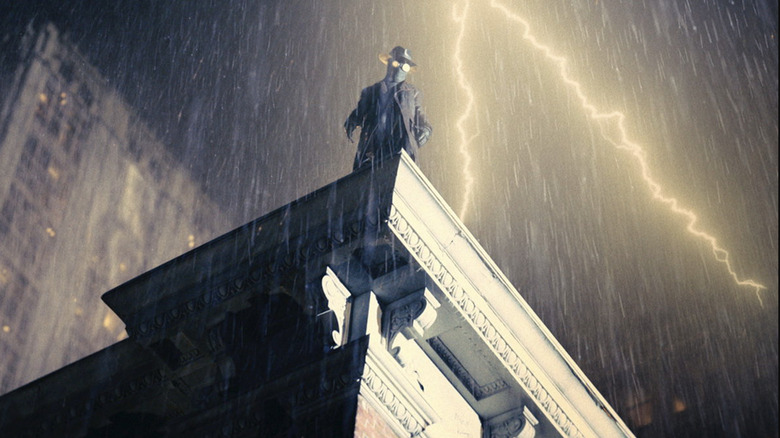
Prime Video’s Nicolas Cage-starring, black and white Spider-Noir series looks fantastic, but the inclusion of a color version feels like a cop-out.
News of all things scary
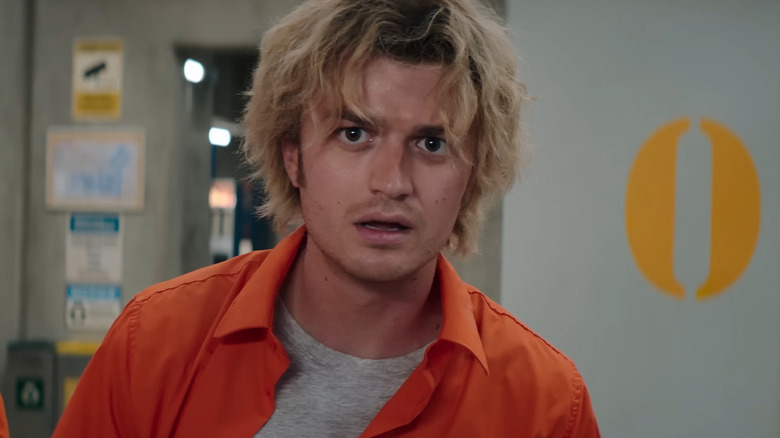
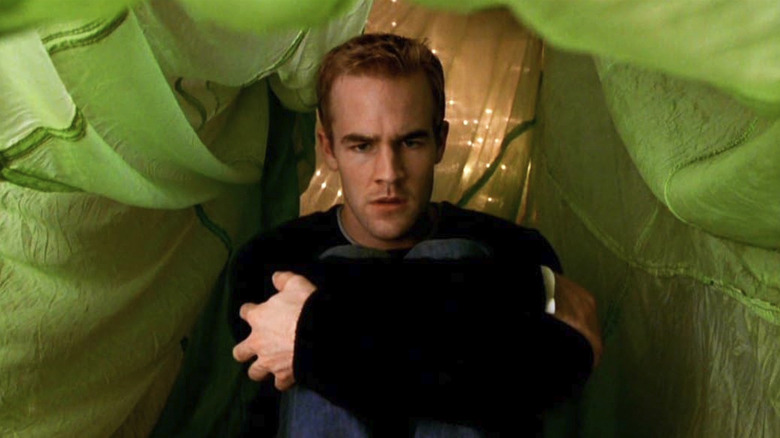
Benedict Wong (Weapons) and Franz Rogowski (Passages) have been cast in The Masque of the Red Death, Deadline reports.
They join the previously announced Mikey Madison (Scream 2022) and Léa Seydoux (No Time to Die) in the A24 production.
The “wildly revisionist and darkly comedic” take on Edgar Allan Poe‘s 1842 on gothic horror story is written and directed by Charlie Polinger (The Plague).
Madison is said to star as twin sisters in a story that sees a mad prince take in the noble class into his castle while a plague devastates the peasantry. The long-lost twin, hidden among the lower class, enter the castle and into a decadent world of orgies, opium, power schemes, revenge, and decapitations.
“It’s definitely more in a dark comedy world,” Polinger told Bloody Disgusting. “It has a much more maximalist tone but explores some similar things [as The Plague] on a very basic level, like group dynamics within a claustrophobic space.”
Julia Hammer and Erik Feig are producing for Picturestart with James Presson and Lucy McKendrick. Polinger executive produces.
The Masque of the Red Death is set to enter production this month in Hungary.

Franz Rogowski in ‘Passages’
The post Benedict Wong & Franz Rogowski Join A24’s Poe Adaptation ‘The Masque of the Red Death’ appeared first on Bloody Disgusting!.
Back in 1963, in his classic tune “A Hard Rain’s a-Gonna Fall,” Bob Dylan sang, “I saw ten thousand whispering and nobody listening.” Years later, in his memoir Chronicles: Volume One, the legendary singer-songwriter would describe the track as a “funeral song,” saying that it spoke of the feeling that there was a “schism” in society and that “black days” were ahead. The lyric highlights what was contributing to that sense of division amongst many: a large-scale breakdown in communication between people. Few were speaking up, and even fewer were able to hear each other in any meaningful way.
That line might spring to mind for any Dylan fans watching Kiyoshi Kurosawa’s 2001 classic, Pulse (it did for me, anyway). It hits on the same sense of loneliness that runs throughout the J-Horror gem, a topic that continues to make the film as culturally relevant today as it was 25 years ago, perhaps even more. As the film points out, there is an ever-widening gulf between us all, and the technology that was initially meant to bridge that chasm is now only adding to it, leaving us no more than ghosts calling out to each other in the dark.
Pulse (titled Kairo, or “Circuit,” in Japan) follows the stories of two individuals who are navigating very different existences in the massive metropolis of Tokyo. Michi (Kumiko Asô) makes a modest living working in a plant shop with her friends. Ryosuke (Haruhiko Katô) is a university student who mostly keeps to himself. Their paths eventually cross after a series of mysterious disappearances and suicides begin to plague their country, and it becomes evident that the dead are somehow managing to bleed into our world through the internet. As ghosts quickly begin to outnumber the living, the two strangers must figure out a way to survive or, perhaps most disquieting, if there’s even a point in doing so.

The seed for Pulse was planted sometime in the 1990’s, recalled Kurosawa during an interview featured in Arrow’s release of the film. He and writer Chiaki Konaka, with whom he had worked on a few of his early pictures (Door III, Gakkô no kaidan F), had been spit-balling ideas for a possible horror film to do together. They eventually landed on a ghost story for the film’s framework, with the duo vowing to make a movie unlike anything that had appeared in the sub-genre to that date. They envisioned entities that were more reminiscent of aliens than spirits, seeing their ghosts “as something extraterrestrial invading our real world.” The project petered out abruptly with no actual plot being written, but that idea itself would remain at the back of the director’s mind for years afterward. When the opportunity arose for him to make another movie after the breakthrough success of his film Cure (1997), Kurosawa gave the idea a dust off.
Initially released in February of 2001, Pulse would later make the rounds at film festivals like TIFF and Cannes before finally receiving a limited North American run in 2005. While some critics didn’t gel with the film (“The line that separates the uncanny and the obtuse has rarely been so thin,” complained Entertainment Weekly’s Owen Gleiberman), it was mostly well received. In his review for Slant magazine, Jeremiah Kipp praised Kurosawa’s “resoundingly empathetic” storytelling style, going on to say that “he cares about the world and the people that live on this fragile planet,” and Anita Gates wrote for the New York Times: “there are very few moments [in the film] that don’t evoke a dreamlike dread of the truly unknown.”
It’s true that Pulse is that rare kind of film that can terrify viewers through sheer atmosphere alone. Shadows engulf the majority of its frames, and you quickly learn that anything could be hiding within that darkness. Eventually, even a simple silhouette in the background of a shot is enough to send goosebumps down your spine. In a recent interview on Umbrella’s 4k release, Kurosawa spoke of a surprising influence in regard to this style of scare. As a child, he was a rabid fan of the classic Hammer horror films, with 1964’s The Gorgon being a minor obsession of his. In particular, it was the shots of the title monster “standing vaguely in the background” during certain scenes that left a huge impression on the young boy. “I don’t know why, but it just scared the hell out of me,” he says today, and you can see him attempting to recreate that same kind of foreboding image in many of his efforts in the horror genre.

Any horror film that tries to utilize an emerging technology within its story always runs the risk of not only dating itself but being deemed “quaint” by viewers years down the road. The exceptions to this rule are usually directly connected to the intentions of the filmmaker. If they’re including the device as a means of making their project topical, then oftentimes their movie will lack the thematic meat to withstand the test of time. But if they’re trying to say something that is true to life, something that resonates with audiences, then people are more likely to forgive whatever dated qualities it might later have.
Pulse is definitely a case of the latter. While its main conceit (the dead are reentering our world through the internet) is admittedly a little silly by today’s standards, it’s the film’s overarching theme that continues to hit home for audiences. “More than anything, Pulse is about isolation,” says Jerry White in his fantastic book The Films of Kiyoshi Kurosawa: Master of Fear. “Specifically, the very human need to connect with another person.” It’s in that sense of loneliness where the movie draws you in.
We crave meaningful contact with others in a time when so many of our interactions feel increasingly shallow. Part of the reason for that superficiality, the movie posits, comes as a result of where a lot of these encounters are taking place: the internet (though you could slip social media into that spot seamlessly today). While that digital arena can certainly lead to legitimate friendships, all too often we never quite get the level of connection we were hoping for. As Kurosawa himself put it years later, “even though you make contact with various people [on these platforms], I think your soul remains quite lonely.”

Ryosuke personifies this well. Unlike Michi, he doesn’t seem to have any friends to speak of. He jumps onto the internet in an attempt to go where the people are (“Everyone else is on it,” he explains later), but instead of finding others to talk to, he is given an endless array of windows into the lives of people who are just as alone as he is. Once again, he finds himself on the outside looking in.
Pulse’s most haunting image is of the stains that are left behind when its characters fade out of existence. Kurosawa himself once described the idea surrounding them as one of the most frightening things he could think of, and it’s a visual that’s come to define his style of existential horror. The movie’s wandering ghosts are lucky in that they are at least corporeal, but those who have disappeared have met a far worse fate.
They are not seen.
They are not heard.
They have melted into the ether, ceasing to be.
Those stains represent not only our fear of the unknown that awaits us beyond death, but also the sensation of isolation itself. It personifies what it’s like to feel completely alone while the world races all around you. To call out and hear nothing back.

The post Trap Them in Their Loneliness: 25 Years of Kiyoshi Kurosawa’s ‘Pulse’ appeared first on Bloody Disgusting!.
Sam Rockwell and Juno Temple have to set aside their differences to prevent the AI apocalypse in the new clip from Good Luck, Have Fun, Don’t Die.
The sci-fi action comedy lands in theaters this Friday, February 13, via Briarcliff Entertainment.
Gore Verbinski (The Ring, Pirates of the Caribbean) is back in the director’s chair for the first time in a decade, with a script by Matthew Robinson (Love and Monsters, The Invention of Lying).
In the film, a man with a detonator bursts into a crowded diner proclaiming to be from the future. This is the 117th time he’s returned with the same imperative. Before time runs out, he must recruit a group of distinctly unqualified diner patrons to stop the impending AI apocalypse and save humanity from the perils of social media.
Haley Lu Richardson, Michael Peña, Zazie Beetz, Asim Chandhry, and Tom Taylor round out the cast.
Verbinski produces alongside Robert Kulzer, Erwin Stoff, Oly Obst, and Denise Chamian.
Good Luck, Have Fun, Don’t Die is rated R for “pervasive language, violence, some grisly images, and brief sexual content.”
The post Sam Rockwell & Juno Temple Get Heated in ‘Good Luck, Have Fun, Don’t Die’ Clip appeared first on Bloody Disgusting!.
The enchanting new poster for The Dreadful features the helmet of the mysterious knight at the center of the Gothic horror tale.
“Game of Thrones” stars Sophie Turner and Kit Harington reunite in the film, in select theaters and on Digital February 20 via Lionsgate.
Set in medieval England, Anne and her domineering mother-in-law Morwen struggle to survive on the outskirts of society. But when a man from Anne’s past returns from war, a curse begins to take shape through a mysterious knight and threatens to destroy them all.
The UK production is written and directed by Natasha Kermani (Abraham’s Boys, V/H/S/85).
Academy Award winner Marcia Gay Harden (The Mist) co-stars along with Laurence O’Fuarain (“The Sandman”) and Jonathan Howard (Godzilla: King of the Monsters).
Turner and Kermani produce alongside Luke Daniels, Greg Lauritano, Lucas Jarach, Adam G. Simon, Bull Blumenthal, and Patrick Hibler.
The Dreadful is rated R for “violence/bloody images and a sexual reference.”

The post ‘The Dreadful’ Starring Sophie Turner & Kit Harington Goes Medieval with New Poster appeared first on Bloody Disgusting!.
